South Florida Privacy Hedge Specialists

Privacy hedges for HOA boards and associations.

South Florida community associations bring us in for perimeter screening, amenity privacy, and a uniform green standard across the community. We scope the work for board budgets, approvals, and the way boards actually decide.

Same-day replies Miami · Fort Lauderdale · West Palm Beach Never sold or shared
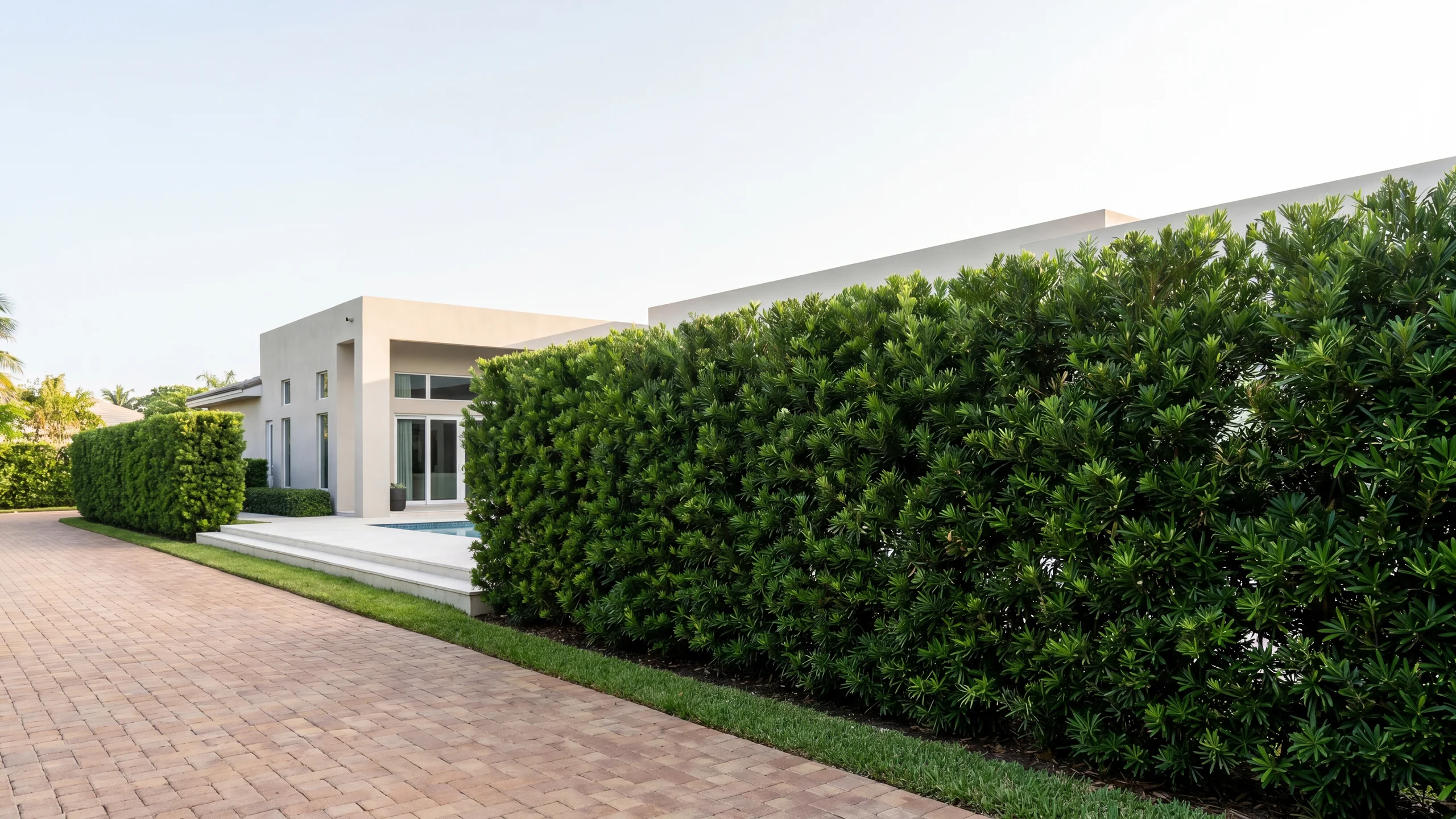
A tall, formal podocarpus hedge lining a South Florida community amenity area, showing the uniform architectural look associations often want for common spaces.

A hedge program a board can stand behind.

Common-area screening that looks uniform, ages well, and holds up to the questions a board has to answer to its members.

An HOA board buys a hedge differently than a homeowner does. A board is spending other people's money, answering to a membership, working inside a budget and often a reserve study, and living with the result on every common-area edge for the next decade. The decision has to be defensible, not just attractive.

We work with South Florida community associations on exactly that. Perimeter screening along community boundaries, privacy around pools and clubhouses, screening for lift stations and dumpster enclosures, and uniform replacement of failing or storm-damaged hedges across a property. The goal is a green standard that looks consistent from one end of the community to the other and stays that way.

Most importantly, we scope the work the way a board needs to receive it: a clear written proposal, a defined scope, an honest timeline, and plant choices the board can explain to its members. The hedge should make the board's job easier, not add another thing to defend at the next meeting.

Why South Florida boards bring us in.

What matters when the customer is a board, not a single homeowner.

Uniform standard across the whole community

A community hedge has to read the same on every edge. We plan species, starter size, and spacing so the line is consistent from the entrance to the back fence, and so future replacements match what is already in the ground instead of standing out.

Written proposals a board can act on

We deliver scope, plant selection, timeline, and pricing in writing, in the form a board needs to review, compare, and vote on. No vague verbal estimates that fall apart when the board asks a follow-up question.

Budget and reserve aware

We scope work to the budget the board is actually working with. For larger programs we can phase the work across budget cycles so a community can get the whole property done without a single oversized assessment.

Our own crew, accountable to one contact

Every community install is planted by our in-house crew. The board talks to one company from proposal to finished line, which means one point of accountability if a question comes up during or after the work.

Species matched to common-area conditions

Community edges face different conditions than a single backyard. Road frontage, salt exposure, lift stations, deep shade under mature canopy. We match the species to each condition so the standard holds across the whole property, not just the easy stretches.

Storm-season realism

South Florida communities lose hedges to storms. We plan community plantings with wind and recovery in mind, and we can prioritize a phased replacement of storm-damaged runs so the most exposed edges get handled first.

How a community hedge program works.

From the first board conversation to a finished, uniform line.

1

Walk the property with the board or manager

We walk the community with a board member or the property manager and map every edge that needs work. We note conditions, existing plant health, and the runs that should be prioritized. The walk produces a real scope, not a guess.

2

Written proposal scoped to the board's decision

We put the scope, species, starter sizes, timeline, and pricing in writing in a form the board can review and vote on. If the board is collecting multiple bids, our proposal is built to be compared on equal terms.

3

Phasing for budget and approvals

If the full program is larger than one budget cycle, we lay out a phased plan that handles the highest-priority edges first and completes the rest on a schedule the board controls. We work around the association's approval and assessment process rather than against it.

4

Install by our own crew

Our crew installs the approved scope, works clean around residents and amenities, and keeps common areas usable during the work. We coordinate access, parking, and resident notice with the property manager.

5

Handover and a plan for keeping the standard

We hand over a care plan the community's landscape maintenance company can follow so the new hedge establishes correctly and the uniform standard holds. For ongoing programs we stay available for the next phase or future replacements.

Project Highlight

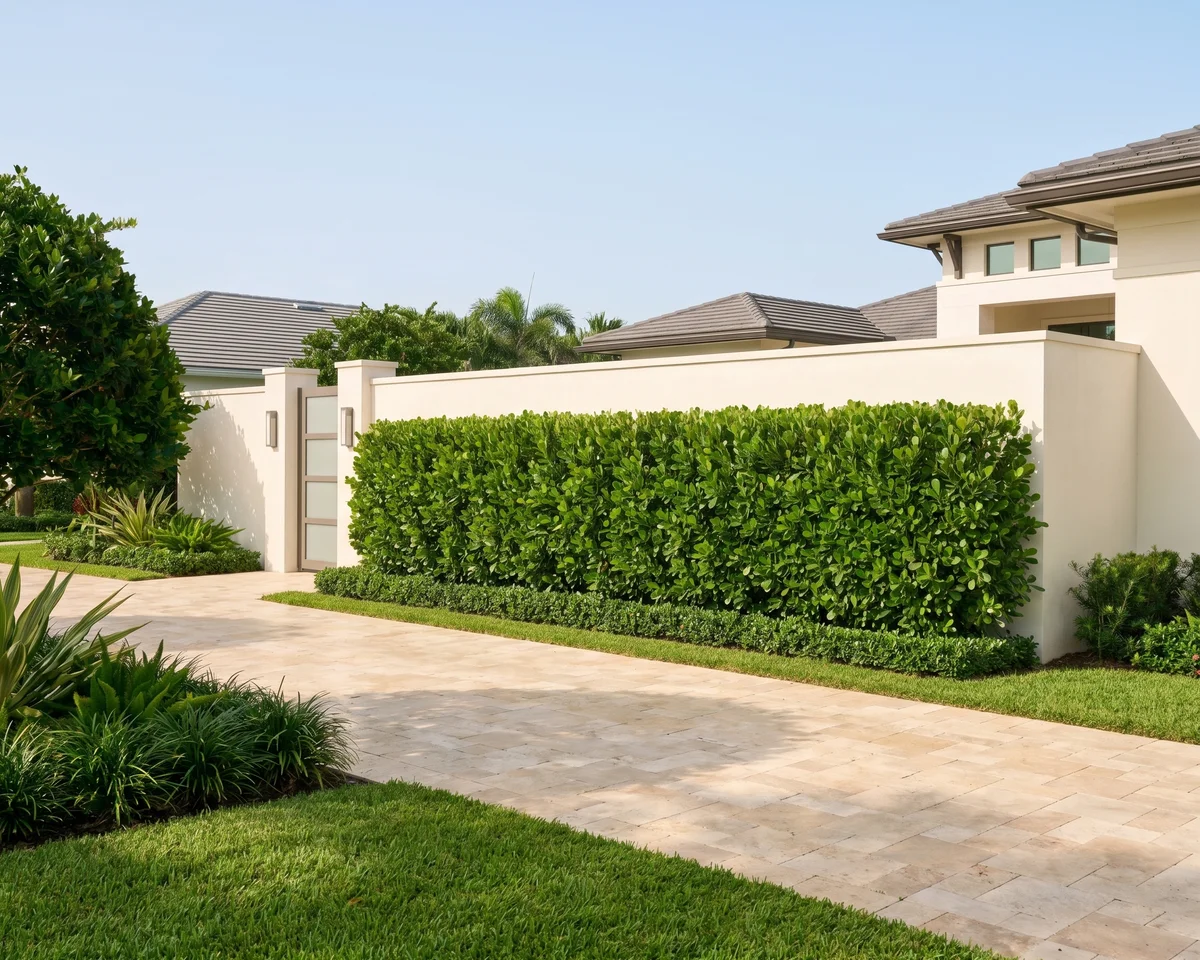
A uniform privacy hedge restored along a Palm Beach Gardens community perimeter, the finished result of a phased association hedge program.

A Palm Beach Gardens community that replaced a failing boundary in phases.

A uniform perimeter standard restored across a property without a single oversized assessment.

The Challenge

A Palm Beach Gardens community association had a perimeter hedge that had been failing for years. Sections were thin, some had been lost to storms and never replaced, and homeowners had filled gaps with mismatched plants. The board wanted a consistent boundary again but could not fund the entire perimeter in one budget year, and previous bids had been all-or-nothing.

Our Solution

We walked the full perimeter with a board member and the property manager and mapped every section by condition. We proposed a uniform species and starter size for the whole boundary, then phased the work across two budget cycles, starting with the most exposed road-facing and entrance runs. The proposal laid out exactly what each phase would cost and deliver so the board could approve it cleanly at a meeting.

The Outcome

Phase one restored the entrance and road-facing edges to a finished, uniform line before that year's peak season. Phase two completed the remaining perimeter the following budget cycle. The community ended up with a single consistent standard again, the board funded it without a special assessment, and the mismatched homeowner gap-fills were replaced with the community standard.

Working with HOA boards and community associations

What a community association needs from a hedge that a homeowner does not.

When a single homeowner installs a hedge, the decision lives with one person and one yard. When an HOA board installs a hedge across common areas, the decision lives with a board, a budget, a membership, and a property that has to look consistent for years. Those are different problems, and they call for a different approach from the installer.

The first difference is uniformity. A homeowner can plant whatever they like. A community has to look like one community. That means the same species, the same starter approach, and the same spacing logic on every edge, plus a plan for matching future replacements to what is already in the ground. A patchwork of mismatched plants is the exact problem most boards are trying to solve, and it is easy to recreate if the install is not planned for consistency from the start.

The second difference is accountability. A board answers to its members. The work has to be documented, the scope has to be clear, and the result has to be defensible at a meeting. A vague handshake estimate does not survive the first homeowner question about why the association spent the money. We build proposals to hold up to that scrutiny.

The third difference is budget structure. Communities work inside annual budgets and reserve studies. A large perimeter program often cannot be funded in a single year without a special assessment, which boards rightly want to avoid. Phasing the work across budget cycles is usually the difference between a program that gets approved and one that stalls.

Where community associations use privacy hedges.

Perimeter and boundary screening.

The most common community project is the perimeter. A green boundary screens the community from roads, neighboring properties, and adjacent development, and it sets the visual standard for the whole property. A consistent perimeter hedge is one of the highest-impact things a board can do for how the community presents at the entrance and along its edges.

Amenity privacy.

Pools, clubhouses, tennis and pickleball courts, and gathering areas all benefit from screening. Amenity hedges give residents privacy while they use shared spaces and soften the look of fencing and hardscape. These are high-visibility areas where a finished, uniform hedge reads as a well-run community.

Utility and service screening.

Lift stations, dumpster enclosures, backflow preventers, and equipment areas are the least attractive parts of any community. A screening hedge hides them without the maintenance burden of a fence. Boards consistently find this is a quick win that members notice.

Uniform replacement of failing or storm-damaged runs.

Many community hedge projects are replacements rather than new installs. Old ficus runs hit by whitefly, storm-damaged sections, and homeowner gap-fills that never matched the original all leave a community looking patchy. Replacing these to a single standard restores the consistent look the community was designed around.

The plant decision for common areas.

Species choice matters more for a community than for a single yard, because the choice gets repeated across the whole property and lived with for a decade. We help boards make a choice they can stand behind.

Clusia for sun and consistency.

For most sunny community edges, Clusia is the workhorse. It fills in densely, holds a clean line with light maintenance, and tolerates the heat and salt that South Florida communities deal with. For a uniform perimeter standard, Clusia is usually the default recommendation.

Podocarpus for formal and shaded runs.

Where a community wants a taller, more formal architectural line, or where mature canopy puts an edge in shade, Podocarpus is the better fit. It is the natural choice for entrance features and amenity areas that call for a more manicured look.

Cocoplum and native options for coastal communities.

Coastal and waterfront communities benefit from salt-tolerant natives. Cocoplum handles direct salt exposure that would stress other species, and it carries native-plant and Florida-Friendly Landscaping credentials that some communities specifically want. For boards weighing native options, our native hedges overview lays out the choices.

How boards decide, and how we fit that.

Boards do not buy on impulse. There is a process, and an installer who respects it is easier to work with than one who does not. We build our involvement around how boards actually operate.

Proposals built to be compared.

Boards often collect multiple bids. We write proposals so they can be compared on equal terms, with the scope, species, starter sizes, and timeline spelled out. A board should be able to see exactly what each bid includes rather than guessing at the differences.

Documentation for the membership.

We provide the documentation a board needs to explain the project to its members, including before-and-after photo records for replacement work. A documented improvement is far easier to defend at an annual meeting than an unexplained line item.

Phasing for budgets and reserves.

For larger programs we lay out phased plans that fit annual budgets and avoid special assessments where possible. The board controls the pace. We handle the highest-priority edges first and complete the rest on the schedule the budget supports.

Coordination with the property manager.

Most communities run through a property management company. We coordinate scheduling, resident notice, access, and parking with the manager so the install does not surprise residents or disrupt amenity use more than necessary.

Florida community context worth knowing.

Florida community associations operate under Chapter 720 for HOAs and Chapter 718 for condominiums, and many communities have their own architectural and landscaping standards on top of state law. Florida law also protects certain Florida-Friendly Landscaping practices, which can matter when a community is choosing between species. We are not attorneys and a board should rely on its own counsel and governing documents for the legal side, but we plan community plantings with these realities in mind and recommend species that fit both the conditions and the kind of standards South Florida communities commonly adopt.

Worth a note on the homeowner side too: individual residents in a community often need their own hedge approved by the same board. That is a different situation from a board buying common-area work, and we cover it on our HOA-approved privacy hedges page for homeowners going through architectural review.

HOA board questions, answered.

What South Florida boards and property managers ask most when scoping a community hedge program.

Yes. We deliver scope, species, starter sizes, timeline, and pricing in writing, in a form a board can review, compare against other bids, and vote on at a meeting. The goal is a proposal that answers the board's follow-up questions before they have to ask them.

Request a board proposal.

Tell us about your community and the edges that need work. We will walk the property and deliver a written proposal your board can review and vote on.